Journal
PCOS, Now PMOS, and Infertility: Why Irregular Periods Can Matter More Than You Think
August 13, 2026 · 4 min read
Last updated

An Irregular Period May Be Telling You More Than You Think
If your period comes every six, eight, or ten weeks, the real concern may not be the missed period itself. It may be that you are not ovulating regularly.
PCOS, now being renamed Polyendocrine Metabolic Ovarian Syndrome, or PMOS, is the most common cause of anovulation worldwide and a leading cause of infertility. The World Health Organization estimates that the condition affects about 10 to 13% of reproductive-aged women, with as many as 70% potentially undiagnosed. For a woman in Trinidad, Barbados, Guyana, or elsewhere in the Caribbean who has spent years hearing that an irregular cycle is simply "how her body works," this can mean the underlying problem is only investigated once she starts trying to conceive.
Why PMOS Can Make Getting Pregnant More Difficult
PMOS can disrupt the hormonal signals involved in developing and releasing an egg. Some women may ovulate occasionally rather than every month, while others may go long periods without ovulating at all. This makes conception harder simply because there are fewer predictable opportunities for pregnancy. It also means a fertility app that assumes ovulation happens around day 14 may be of limited use for someone whose cycles vary dramatically from month to month. The good news is that PMOS-related fertility problems are often linked to irregular ovulation rather than an inability to become pregnant altogether. WHO identifies abnormal ovulation and infertility among the major reproductive effects of the condition.
The Caribbean Side of the Fertility Conversation
There is another side to this that medical charts rarely capture. In Caribbean families, questions such as "When allyuh having a baby?" can start long before a couple has decided whether they even want to discuss fertility publicly. A woman may therefore be dealing with irregular periods, medical appointments, and uncertainty while simultaneously navigating family expectations and unsolicited advice. Access to fertility care can also be expensive or limited. WHO reported in 2025 that availability, affordability, and public financing for infertility diagnosis and treatment remain major challenges globally. That makes early investigation important, particularly when periods are consistently very irregular or absent.
Metabolic Health and Fertility Are Connected
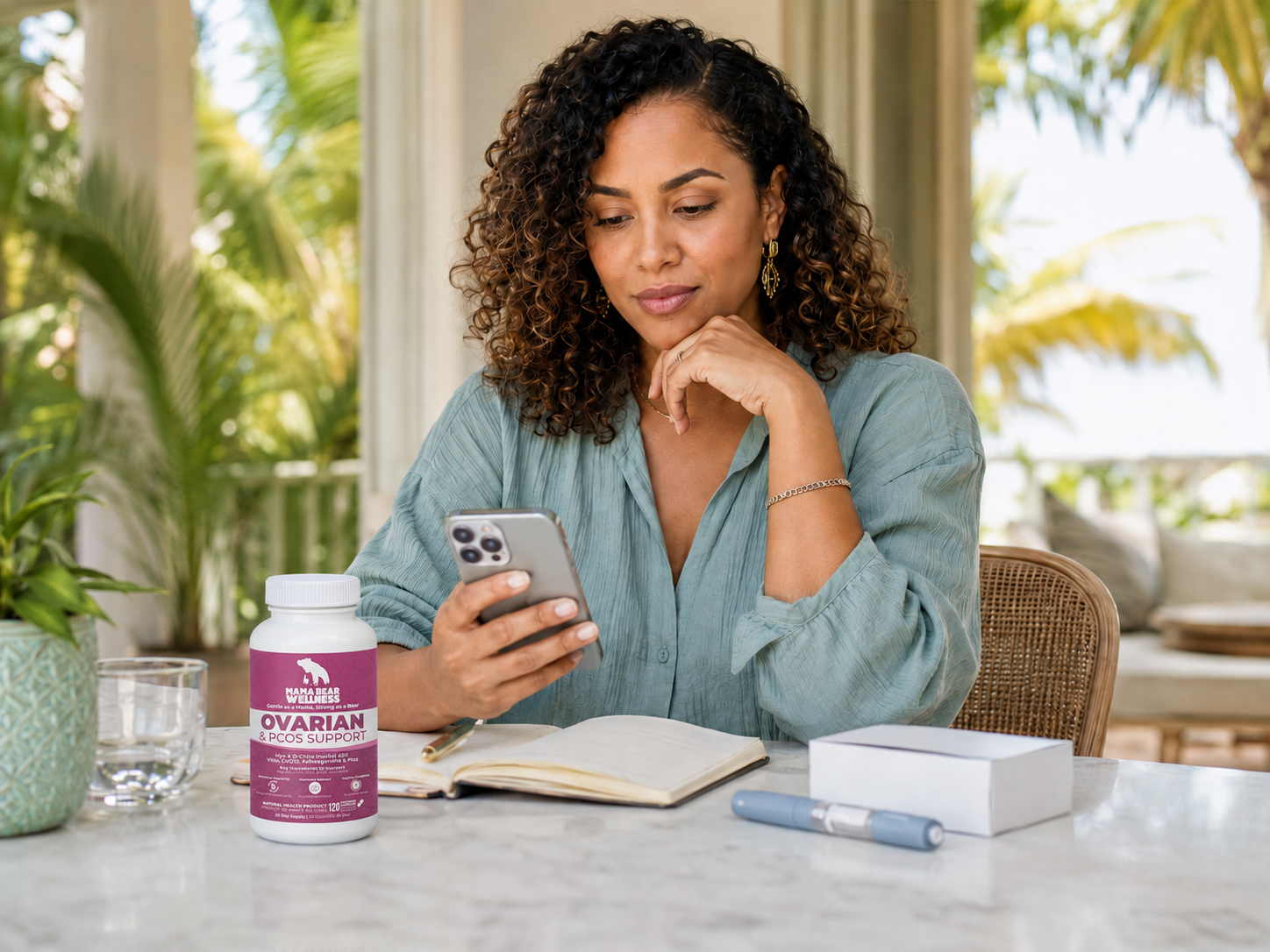
The change from PCOS to PMOS is more than a cosmetic name change. It reflects growing recognition that this is a broader endocrine and metabolic disorder, not simply a problem involving ovarian "cysts." Insulin resistance is common in women with the condition and is one reason researchers have investigated nutrients such as myo-inositol and D-chiro-inositol. These are two of the main active ingredients in Mama Bear Wellness Ovarian & PCOS Support. A 2024 systematic review prepared to inform the international PCOS guideline found possible benefits for some metabolic outcomes, but concluded that the overall evidence for inositol remains limited and inconclusive. This is an important distinction. Nutritional support may form part of a broader wellness strategy, but it should not be marketed or viewed as a replacement for fertility assessment or treatment.
What About CoQ10?
Coenzyme Q10, or CoQ10, is another ingredient that has been studied in women with PCOS because of its role in cellular energy production and antioxidant activity. A systematic review and meta-analysis found potential improvements in some metabolic and hormonal measures among women with PCOS who received CoQ10 supplementation. Research on CoQ10 and female fertility more broadly has also suggested a possible improvement in clinical pregnancy rates among some women undergoing assisted reproductive treatment, although an improvement in live birth rates has not been clearly demonstrated. This makes CoQ10 an interesting supportive ingredient, but it would be inaccurate to describe it as an infertility treatment on its own.
PMOS-Related Infertility Is Often Treatable

For women whose main fertility problem is irregular or absent ovulation, there are established medical treatments. The international evidence-based guideline for PCOS recommends letrozole as the first-line medication for ovulation induction in women with anovulatory infertility and no other identified infertility factors. Doctors may also investigate the partner, fallopian tubes, and other possible fertility factors because having PMOS does not mean every difficulty becoming pregnant is automatically caused by PMOS.
The Bottom Line
Having PMOS can make getting pregnant more difficult, but it does not mean pregnancy is out of reach. For many women, the most important first step is finding out whether they are ovulating regularly and understanding the hormonal and metabolic factors affecting their cycle. Lifestyle, nutrition and supportive ingredients such as inositols and CoQ10 may form part of the bigger picture, while medical treatment is available when ovulation needs additional help.
For Caribbean women especially, fertility conversations deserve to move beyond whispers, family pressure and the assumption that irregular periods are something you simply have to live with. Knowing what your cycle is telling you can turn uncertainty into a much clearer plan.
Sources
- World Health Organization. Polycystic Ovary Syndrome. Updated 2026.
- Fitz V, et al. Inositol for Polycystic Ovary Syndrome: A Systematic Review and Meta-analysis to Inform the 2023 International Evidence-Based PCOS Guideline. Journal of Clinical Endocrinology & Metabolism. 2024.
- Zhang T, et al. Efficacy and Safety of Coenzyme Q10 Supplementation in the Treatment of Polycystic Ovary Syndrome: A Systematic Review and Meta-analysis. 2023.
- Monash University, May 13, 2026. Polyendocrine Metabolic Ovarian Syndrome: New name to improve diagnosis and care.